Meta Ads Creative Automation: Generate Dozens of Ad Variations for Creative Testing, Fast
Generate dozens of ad variations in minutes with creative automation to reduce costs, prevent ad fatigue, and improve Meta campaign performance.

Try the workflow instead of comparing it
See what an AI ad generator makes from your product
Paste your product page and get a batch of ready-to-use static image ads without another design tool stack.
Free to try No signup No prompt writing
Struggling to scale your Meta ad campaigns? The problem likely isn’t your targeting or budget - it’s your ad content. Traditional methods can’t keep up with the demand for fresh ad variations, leading to higher costs and lower performance. Meta’s algorithm thrives on variety, but manual production limits most advertisers to 3–5 variations per campaign.
Here’s the solution: creative automation. This approach allows you to generate dozens of ad variations in minutes, cutting production time and costs while improving campaign performance. Advertisers using automation report:
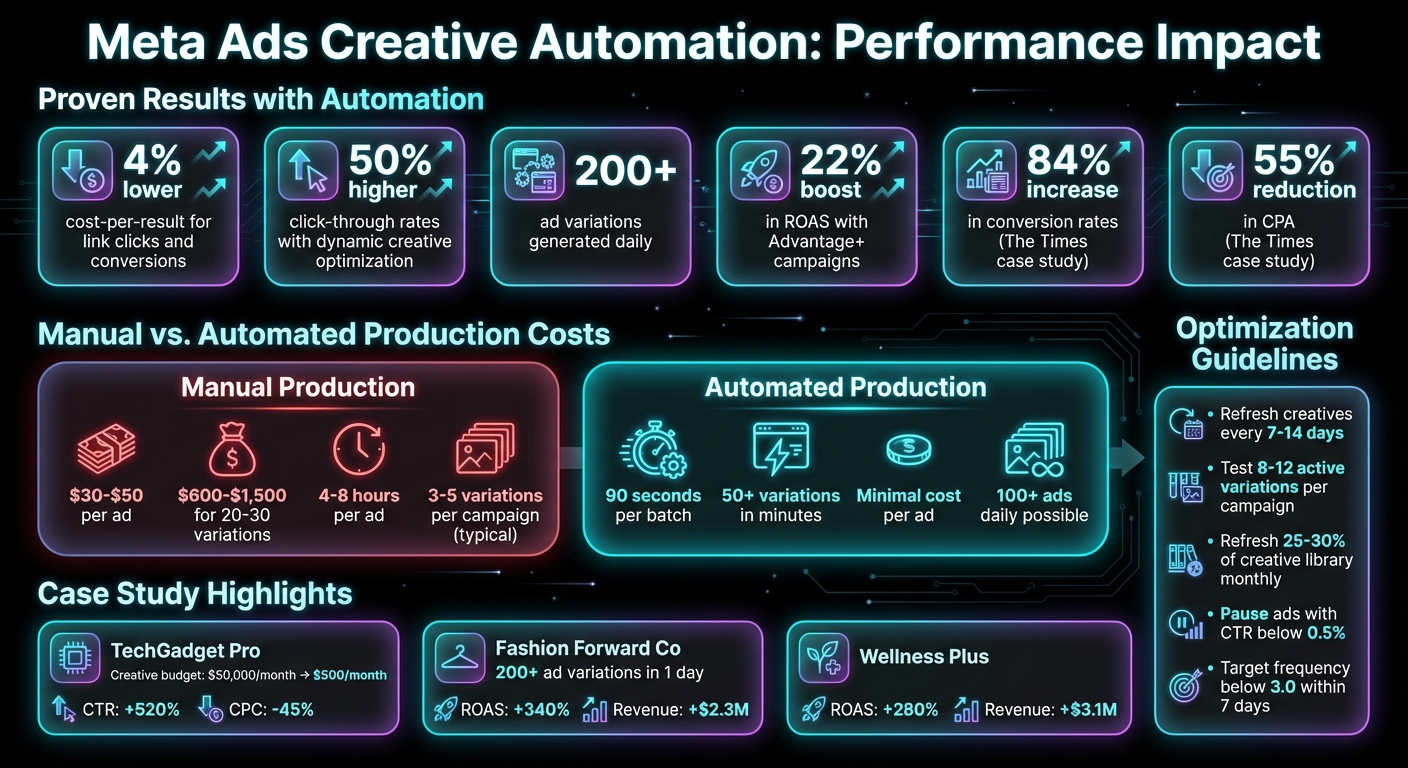
- 4% lower cost-per-result for link clicks and conversions.
- 50% higher click-through rates with dynamic creative optimization.
- Faster testing and scaling with up to 200+ ad variations daily.
By automating Meta ad production, you eliminate production bottlenecks, reduce creative fatigue, and give Meta’s algorithm the diversity it needs to optimize results. Tools like Aden’s Lab make this process seamless, pulling content directly from your landing page to produce ready-to-upload ads in seconds. The result? Lower costs, higher returns, and more time to focus on strategy.
Key takeaways:
- Manual production is too slow and expensive to scale effectively.
- Automation enables rapid testing of 20–30 variations per campaign.
- Regularly refreshing content (every 7–14 days) prevents ad fatigue.
Ready to improve your Meta ad performance? Automation is no longer optional - it’s the key to staying competitive.
Meta Ads Creative Automation: Key Performance Statistics and Benefits
Why Manual Creative Production Doesn't Work at Scale
Creative Fatigue Kills Ad Performance
Meta's algorithm does more than just deliver your ads - it constantly monitors how users engage with them. The trouble begins when the same creative is shown too often. Audiences start tuning it out, click-through rates plummet, ad frequency climbs above 4.0, and cost-per-acquisition can skyrocket in just a few weeks. This isn’t an issue with targeting - it’s creative fatigue taking its toll.
"The algorithm gets bored, and so do your audiences." – Admetrics
The solution? A steady flow of new ads. But here’s the catch: manual production simply can’t keep up with how quickly audiences lose interest. By the time new creatives are ready, the old ones have already lost their effectiveness, leading to campaign pauses or wasted ad spend.
And it’s not just about performance - manual production also drains your budget and eats up valuable time.
Traditional Creative Production Is Expensive and Slow
Creating Meta ads manually comes with a hefty price tag. Designers typically charge $30–$50 per ad. To test 20–30 variations effectively, you’re looking at costs between $600 and $1,500 per round. Tack on revisions, feedback cycles, and approval delays, and what should be a quick process drags on for days - or even weeks. Meanwhile, your campaigns either sit idle or continue burning money on fatigued ads.
There’s also the opportunity cost to consider. Every delay in rolling out new ads means fewer chances to test fresh ideas or scale successful campaigns. Traditional workflows force you to choose between speed and quality - neither of which helps your performance in the long run.
Manual Methods Limit How Many Ads You Can Test
Most advertisers relying on manual production only manage to test 3–5 ad variations per campaign. Compare that to high-performing accounts, which typically run 8–12 active creative variations per campaign and refresh 25–30% of their creative library monthly. Without an in-house design team, hitting these benchmarks is nearly impossible.
This limitation doesn’t just slow growth - it can bring it to a halt. Testing only a handful of creatives means you risk overlooking the winning angles that could slash your Customer Acquisition Cost (CAC) or drive a higher return on ad spend. Meta’s algorithm thrives on variety and volume. Without enough diverse assets, you face what’s often called a "monotony tax" - higher CPMs, reduced reach, and weaker auction performance.
"Your creative is now your targeting." – Admetrics
Put the playbook to work
Apply this playbook to your page
Paste your website and the Lab will turn the strategy you are reading into ready-to-test ads.
Free to try No signup No prompt writing
How To Build a Meta Ad Creative Machine (Step-by-Step)
How Creative Automation Fixes These Problems
Creative automation completely changes how ads are produced. Instead of waiting days for a designer to create a few ads, you simply drop a link and receive dozens of ad variations in minutes. It’s not just faster - it eliminates the manual steps that slow everything down.
This shift is crucial because Meta’s algorithm thrives on ad volume and variety. With the ability to generate 50+ ad variations in the time it used to take to outline a single concept, you no longer have to trade off between speed and scale. The system pulls directly from your product’s landing page, extracting key benefits, addressing objections, and highlighting proof points - removing the guesswork from crafting the message.
The cost savings are immediate and substantial. Traditional production can cost $30–$50 per ad, meaning a test of 20 variations might run $600–$1,000. Automation reduces this drastically. For instance, TechGadget Pro slashed their creative budget from $50,000 per month to just $500 while achieving a 520% boost in click-through rates and a 45% drop in cost-per-click while you analyze and optimize CPA.
Here’s how this streamlined process delivers real results.
Generate Dozens of Ads in Minutes
Aden’s Lab can create high-quality static Meta ads in about 90 seconds using just a website link. Paste your URL, and the system automatically pulls images, writes copy, and formats ads for platforms like Facebook and Instagram. This speed allows businesses to launch 100+ ads daily, giving Meta’s algorithm the variety it needs to optimize performance.
Compare this to manual workflows, which can take 4–8 hours per ad even with a dedicated designer. Fashion Forward Co. is a prime example: they generated over 200 ad variations in a single day, leading to a 340% increase in return on ad spend and $2.3 million in additional revenue.
No Briefs, No Prompts, No Back-and-Forth
Beyond speed, creative automation eliminates the back-and-forth that often slows down production. Unlike other tools that require detailed prompts or complex settings, Aden’s Lab skips all that. The system analyzes your landing page, identifies the key selling points, and produces ads that are ready to upload. This cuts 60–80% of the time typically spent on coordination and revisions. As Sarah Chen, CMO of Fashion Forward Co., put it:
"ADEN'S LAB created 200+ ad variations in one day. Our previous agency took 3 weeks for 10 ads."
Designed for Meta’s Algorithm and Performance
Automated creatives aren’t just fast - they’re built to perform. Aden’s Lab applies direct-response principles, using clear headlines, eye-catching visuals, and strong calls-to-action that grab attention and drive clicks. These ads are tailored to Meta’s delivery system, which rewards high engagement by improving auction performance and lowering costs.
Meta’s own data shows that automated creative adjustments, like format tweaks and visual enhancements, can reduce cost-per-result by 4%. Aden’s Lab ensures every ad meets Meta’s specs for feeds, Stories, and Reels, so there’s no need for manual adjustments. Dr. Amanda Foster, founder of Wellness Plus, shared her experience:
"The AI-created health and wellness ads are incredibly persuasive. They understand the emotional triggers that drive our customers to buy better than our $10k/month agency ever did."
This approach led to a 280% increase in ROAS and $3.1 million in additional revenue.
When ads are designed with Meta’s algorithm in mind - not just made to look appealing - they deliver higher click-through rates, lower acquisition costs, and stronger returns on ad spend from the start. This integration allows you to focus on strategy while the system handles the heavy lifting of production.
How to Use Creative Automation for Testing and Scaling
The process is simple: create ads, test them, and maintain a steady flow of new ideas. Thanks to automated tools, you can now produce ads quickly and efficiently, making it easier to test Meta's recommended volume. Imagine generating 50 ads in the same time it used to take to make just three. Instead of guessing what works, you let the data guide you.
With production delays out of the way, here's how to put these automated processes into action step by step.
Step 1: Generate Ad Variations in Minutes
Start by dropping your URL into ADEN's LAB and hitting "generate." In less than 90 seconds, the tool produces dozens of ready-to-use static Meta ads. It automatically pulls product images, writes headlines, and formats everything for Facebook and Instagram.
This skips the need for lengthy creative briefs while ensuring each ad highlights your landing page's strengths. Once generated, the ads are available as image files with text variations, ready for upload - no extra setup or instructions needed.
Step 2: Launch Ads and Monitor Performance
Head to Meta Ads Manager, create a new campaign, and use tools like Meta's Advantage+ or dynamic creative optimization. These features mix and match your creative elements automatically. Upload your ads in bulk, target a broad audience, and allocate a daily budget of $50–$100 per ad set to test 10–20 variations.
Track key metrics like CTR (click-through rate), CPA (cost per acquisition), and ROAS (return on ad spend) during the first 3–7 days. Aim for 50–100 clicks per ad to get reliable data. Ads that perform well typically show a CTR above 1–2%, a CPA below your target (often $10–$20, depending on your product), and a ROAS of 3x or higher. For example, The Times saw an 84% boost in conversion rates and a 55% reduction in CPA using automated creatives in Meta Advantage+ campaigns.
After 48–72 hours, pause ads with a CTR under 0.5% or a CPA exceeding 1.5x your target. Take your top-performing ads and duplicate them into new ad sets with higher budgets - jumping from $50 to $200 daily, for instance. Use Meta's delivery insights to watch for signs of fatigue, like rising frequency. This "kill fast, scale winners" approach can save 30–40% in wasted spending by focusing on the top 20% of creatives.
Once your ads are performing well, the key is to keep them fresh to maintain results.
Step 3: Refresh Creatives Regularly
Meta's algorithm thrives on fresh content. Ads can start to lose effectiveness after 7–14 days, with CTRs dropping by 20–50%. To combat this, update your creative assets frequently. Add 20–30 new variations every 7–10 days or whenever you notice CTRs falling by 20–30%. For campaigns spending over $5,000 daily, consider refreshing even more often.
High creative volume can lead to a 22% boost in ROAS in Meta Advantage+ campaigns. By automating the process, you ensure a steady stream of new content, keeping engagement high and costs low while avoiding ad fatigue.
Common Meta Ad Creative Mistakes and How to Avoid Them
Automation has revolutionized how quickly and efficiently Meta ad creatives can be produced and refreshed. But even with these advancements, common mistakes can still sneak in, quietly draining budgets and holding campaigns back. Let’s dive into a few pitfalls advertisers often encounter and how to sidestep them.
Running the Same Ad Type Too Long
Sticking with a single creative format or message for too long can lead to audience fatigue. This often results in lower engagement and higher costs. Take Allbirds, for example. In Q2 2023, they tackled this issue by rotating five distinct creatives every seven days. The result? A 22% boost in click-through rates and a 17% drop in cost-per-click over three months.
Instead of making minor tweaks to existing ads, try introducing entirely new angles. This could mean mixing user-generated content with professional product shots or testing varied messaging styles. Tools like ADEN's LAB make it easy to generate fresh ad variations in minutes - just drop in your link, and you're set. Beyond keeping your creative rotation fresh, it’s critical to pay attention to the insights your ad testing generates.
Ignoring Data from Creative Tests
Skipping over the data from creative tests is like leaving money on the table. Advertisers who test at least three ad variations and use the results to guide decisions see, on average, a 20% higher click-through rate and a 14% lower cost per action. The real issue arises when underperforming ads aren’t paused, and high-performing ones aren’t scaled.
Jon Loomer of Jon Loomer Digital puts it best:
"You're likely adding strategy on top of strategy, layering in various hacks and recommendations along the way, and you have no idea what's truly working and what isn't."
To avoid this, set clear performance benchmarks before launching. For example, if an ad reaches 1,000 impressions but has a click-through rate below 1%, pause it. Similarly, if an ad’s frequency surpasses 3.0 within seven days, it’s time to refresh the creative or broaden the audience. By letting data guide your decisions, you can focus your budget on what works and cut what doesn’t. Another big misstep? Over-editing automated creatives.
Over-Editing Automated Creatives
Automated tools like ADEN's LAB are designed to work seamlessly with Meta’s delivery systems. They handle optimizations like adjusting text placement, tweaking video playback speed, or expanding backgrounds for specific ad placements. However, the temptation to manually tweak every detail - colors, headlines, layouts - can hurt more than it helps.
Over-editing strips away the built-in optimizations that make automated ads effective. The smarter move is to trust the system’s outputs for most of your ads. If something is glaringly off-brand or broken, go ahead and fix it. But resist the urge to micromanage every element. Let the performance data guide you instead. By trusting the process and using ADEN's LAB as intended, your campaigns will stay streamlined and optimized for success.
Why Creative Automation Is Now Required for Meta Ads
Automation has completely changed the game for creating ad content. Imagine this: one marketer using automation can churn out and test 100 ad variations in the same time it takes another marketer to create just a handful manually. That speed advantage doesn’t just save time - it directly fuels better ad performance and smoother scaling.
Meta's algorithm thrives on fresh, diverse creative content. Sticking with stale ads? You’ll get penalized. On the flip side, Advantage+ campaigns, powered by tools like the GEM model, have shown a 22% boost in ROAS and up to a 5% lift in ad conversions. These improvements aren’t just small wins - they’re the kind of results that can separate thriving campaigns from ones that stall out. For instance, one major publication tripled its creative output and saw a noticeable jump in ad performance.
For small businesses and startups, this shift is a game-changer. Gone are the days of relying on expensive agencies to compete on creative volume. With AI tools for Meta ads like ADEN'S LAB, even a single marketer can generate dozens of Meta-ready ads in minutes - no prompts, no setup, no steep learning curve. This makes it possible for small teams to produce at the same level as full creative departments.
The reality is, manual creative production now costs more than adopting automation. It slows down the process of testing ideas and finding high-performing ads, ultimately driving up costs per result. Meanwhile, competitors using automation are scaling faster and spending less. Clive Record, President of Global Solutions at Dentsu, summed it up perfectly:
"With Meta's 'Advantage+ AI' tools we've been able to unlock new levels of creative efficiency, allowing us to focus on higher-level strategic work".
The evidence is clear: automation delivers performance gains, cost savings, and the ability to avoid creative fatigue. It’s no longer an optional tool - it’s a necessity for staying competitive, maximizing ROI, and keeping up with the pace of modern advertising. The real question isn’t whether to adopt automation, but how fast you can get started.
FAQs
How many ad variations should I test per campaign?
Start by testing 10–20 ad variations per campaign. This approach helps you gather enough data to spot trends and figure out what resonates best with your audience. While some suggest creating dozens of variations rapidly to uncover top performers, it’s more important to strike a balance - enough options to learn from, but not so many that analyzing the results becomes overwhelming. Focus on meaningful insights over sheer volume.
When should I refresh creatives to avoid fatigue?
Refreshing your creatives regularly is key to maintaining strong performance. When engagement starts to drop or your ads become less effective, it's a clear sign of fatigue. Ignoring these signals can lead to stagnating or even declining results. To avoid this, keep a close eye on your metrics and update your creatives as soon as you notice a dip in performance.
How do I scale winners without wasting budget?
To grow successful campaigns effectively, prioritize automation and data-driven creative testing. The key is to produce a variety of ad variations quickly, test them rigorously, and pinpoint the ones that perform best. Once you identify those high-performing ads, allocate more budget to them, while reducing spend on ads that aren't delivering results.
When scaling, increase budgets gradually for top-performing ads to maintain stability, and keep introducing new creative ideas to prevent ad fatigue. Automating this entire process helps ensure your ads stay fresh and relevant, while cutting down on wasted resources spent on ads that don't work.
Your next ad batch starts here
Finish with a ready-to-test ad batch
Paste your website to generate static creatives. Drop the link → get ads in about 90 seconds → upload them to Meta → scale.
Free to try No signup No prompt writing